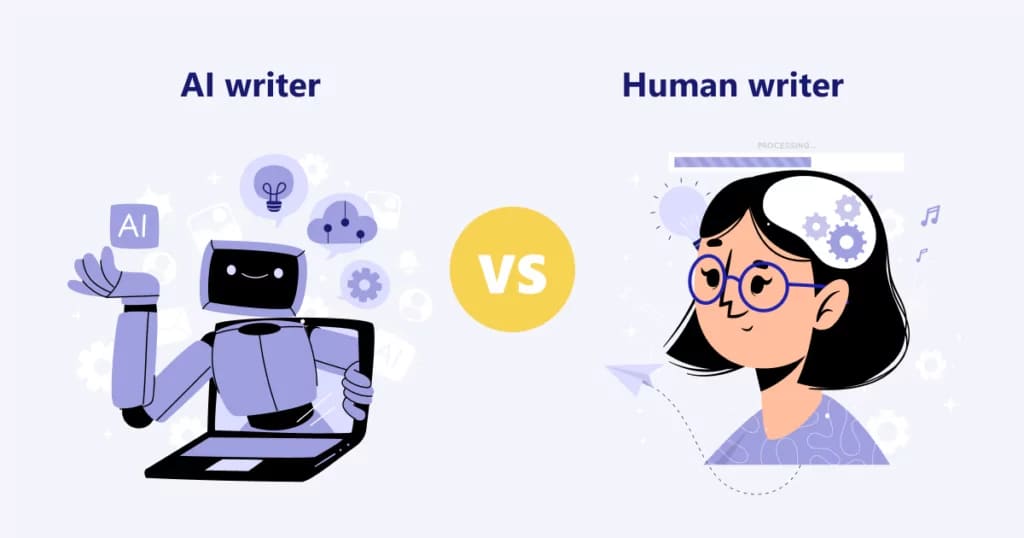
The debate between human SEO content writers and AI writing tools has reached a critical juncture in 2025. While AI capabilities have expanded dramatically, the question isn’t really about who wins – it’s about understanding when each approach delivers the best results for your content strategy. The reality is more nuanced than a simple victory declaration, as both human writers and AI tools bring distinct, powerful advantages to modern content creation. This guide will provide a deep dive into the strengths of both, how they can work together, and how you can build a content strategy that is both efficient and highly effective.
The Current State of Content Creation in 2025
The content landscape has transformed significantly with AI tools becoming increasingly sophisticated. To understand where we’re going, it’s important to know where we are now, as the technology has moved from simple assistance to a central role in many marketing departments.
The Evolution from Text Generators to Content Platforms
Modern AI writing assistants can now generate full-length blog posts in under 15 seconds, optimize for SEO automatically, and even detect brand voice patterns. This is a world away from the clunky text generators of a few years ago. Tools like Surfer AI, Jasper, and StoryChief have evolved from simple writing aids to comprehensive content operations platforms that handle everything from keyword research to multi-channel publishing. They are now integral parts of the marketing tech stack for many companies.
Market Demand and Shifting Job Roles
Despite these advancements, human content writers remain in high demand. The average content writer in the USA earns approximately $58,000 per year, with experienced writers in technical fields commanding $34 or more per hour. SEO specialists earn even more, with an average annual salary of $74,795 plus bonuses averaging $5,552. These salary figures demonstrate that businesses still value human expertise, even as AI tools proliferate. New roles like “AI Content Strategist” and “Marketing Prompt Engineer” are emerging, focusing on leveraging AI tools effectively rather than being replaced by them.
The persistence of strong salaries for human writers reveals an important truth: companies recognize that effective content creation requires more than just generating words. At LADSMEDIA, we’ve seen first-hand how the most successful content strategies leverage both human creativity and AI efficiency to achieve results that neither could accomplish alone.
In essence, 2025 is not about replacement but evolution. As AI platforms become more powerful, the value of human strategic oversight has only increased, setting the stage for a collaborative future. Now, let’s explore what makes AI so powerful in the first place.
What AI Writing Tools Excel At
AI’s primary advantages lie in its ability to process data and execute tasks at a scale and speed that is impossible for humans. This is where businesses can gain a significant competitive edge if they leverage the technology wisely.
Speed and Scale
AI writing tools have revolutionized content production speed. Writesonic can generate 1,500-word drafts in approximately 15 seconds, while platforms like StoryChief can create entire content calendars and campaigns in minutes. This velocity allows businesses to maintain consistent publishing schedules and respond quickly to trending topics or algorithm changes. For example, a business launching in 10 different countries could use AI to generate 10 localized versions of a press release in the time it would take a human to write one.
The scalability advantage extends beyond individual pieces. AI tools can generate multiple variations of content simultaneously, create translations instantly, and repurpose existing content across different formats without requiring additional human hours. For businesses needing high-volume content production, this efficiency is transformative.
Advanced SEO Optimization Capabilities
Modern AI tools integrate sophisticated SEO features that were once the exclusive domain of specialized consultants. Surfer AI uses a red/amber/green scoring system that analyzes word choice, sentence length, headers, and keyword density to optimize content for search rankings. These platforms can identify content gaps by analyzing top competitors, suggest semantic keywords (LSI keywords) to improve topical authority, and even predict cost-per-click for targeted terms. They are also invaluable for technical SEO tasks like generating schema markup or writing meta descriptions at scale.
AI-powered SEO tools excel at technical optimization tasks that humans find tedious. They automatically implement schema markup, optimize meta descriptions, ensure proper header hierarchy, and maintain ideal keyword density without the keyword stuffing that plagued earlier SEO efforts. The consistency of this optimization across large content libraries would be nearly impossible for human writers to maintain manually.
Data Processing and Analysis
AI tools process vast amounts of competitor data, search trends, and user behavior patterns to inform content strategy. They can analyze top-ranking pages for any keyword, identify common elements (like the use of bullet points, average word count, or common questions), and suggest content structures proven to perform well. This data-driven approach removes guesswork from content planning and helps predict which topics will resonate with audiences.
The analytical capabilities extend to performance monitoring. AI tools track engagement metrics, suggest content refreshes based on declining performance, and identify opportunities for improvement that humans might miss. Weekly automated audits and real-time optimization suggestions keep content competitive without constant manual oversight.
While AI’s ability to handle speed, scale, and data is undeniable, these strengths primarily cover the “science” of content creation. True connection and authority, however, still rely on the “art” that only a human can provide.
Where Human Writers Maintain Their Edge
While AI is a powerful tool, it lacks the genuine experience, creativity, and strategic understanding that defines high-quality, trustworthy content. These human elements are becoming more critical as both audiences and algorithms grow more sophisticated.
Authentic Voice, Empathy, and Creativity
While AI can mimic brand voice to some extent, human writers bring genuine personality and creative flair that resonates with readers. The subtle nuances of humor, empathy, and cultural understanding that make content truly engaging still require a human touch. Writers can craft narratives that connect emotionally with audiences, weaving personal experiences and unique perspectives that AI cannot authentically replicate. This ability to build a community and foster brand loyalty is uniquely human.
Human writers excel at understanding context beyond what’s explicitly stated. They can read between the lines of client briefs, understand unspoken brand values, and create content that aligns with company culture in ways AI tools struggle to achieve. This intuitive understanding becomes particularly valuable for brands targeting specific demographics or building thought leadership.
Complex Subject Matter and First-Hand Experience (E-E-A-T)
Technical topics, industry-specific content, and specialized knowledge areas remain firmly in the human domain. While AI can aggregate existing information, it cannot generate genuinely new insights or draw from personal professional experience. This is critical for Google’s E-E-A-T (Experience, Expertise, Authoritativeness, and Trustworthiness) guidelines. An AI cannot have first-hand “experience” using a product, providing a service, or visiting a location.
Expert writers provide original research, conduct interviews, and synthesize complex information in ways that demonstrate true understanding rather than pattern matching. They can identify subtle inaccuracies, challenge conventional wisdom, and provide nuanced analysis that adds genuine value to discussions in their field. This is why SEO consultants earning up to $145,000 at senior levels are valued for an expertise that AI cannot replicate.
Strategic Thinking and Adaptation
Content strategy requires understanding business goals, market dynamics, and audience psychology at levels beyond AI’s current capabilities. Human writers can pivot strategies based on subtle market shifts, interpret ambiguous feedback, and make creative leaps that connect seemingly unrelated concepts. They can also manage brand risk, understanding how a piece of content might be perceived and avoiding messaging that could lead to backlash.
Our team has helped clients navigate algorithm updates and industry changes by applying strategic thinking that goes beyond data analysis. Human writers can anticipate reader objections, address unstated concerns, and craft persuasive arguments that account for emotional and logical decision-making processes.
Navigating Ethical Considerations and Brand Safety
A critical area where humans are essential is in navigating the ethical minefield of AI. AI models are trained on vast datasets from the internet, which can contain hidden biases, outdated information, and even hateful content. A human writer is the final line of defense to ensure that the content published is fair, accurate, and aligned with brand values. Furthermore, AI can inadvertently generate text that is too similar to its source material, creating a significant risk of plagiarism if not carefully checked by a human editor.
The unique strengths of human writers—creativity, deep expertise, and ethical judgment—are not just “nice-to-haves”; they are foundational for building trust. The challenge, then, isn’t to choose between human and AI, but to create a system where they work together.
The Reality of Integration: Building a Hybrid Workflow
The most successful content operations in 2025 use hybrid approaches that combine AI efficiency with human oversight. This collaboration allows teams to produce more content without sacrificing the quality, authenticity, or accuracy that builds a loyal audience.
A Practical Hybrid Workflow Model
Instead of viewing it as a competition, think of it as a partnership. Here is an effective step-by-step workflow:
- Human Strategy: A human strategist defines the business goal, target audience, and primary keywords based on search intent.
- AI Research: Use an AI tool to perform initial SERP analysis, identify competitor weaknesses, and generate a content brief with related keywords and suggested headings.
- AI First Draft: Generate a first draft with the AI to create the basic structure and cover the main points.
- Human Enrichment & Editing: The human writer takes over. This is the most critical step. They rewrite for brand voice, add personal experiences (E-E-A-T), include expert quotes, fact-check all claims, and add creative storytelling elements.
- Human Finalization: The writer performs a final review, ensures the article flows logically, and publishes it using a checklist for SEO-friendly content.
Mastering the Craft: Prompt Engineering for Quality Output
The quality of an AI’s first draft depends entirely on the quality of the human’s instructions. “Prompt engineering” is the skill of crafting detailed prompts to get better results. Instead of “Write a blog post about SEO,” a better prompt would be:
- “Act as an expert SEO strategist with 15 years of experience. Write a 1,200-word blog post for an audience of small business owners who are new to SEO. The tone should be encouraging, authoritative, and easy to understand. Cover the topics of keyword research, on-page SEO, and link building. Include a brief introduction and a concluding summary.”
This level of detail, including persona, audience, tone, and structure, will yield a much more useful first draft, saving significant editing time.
Quality Control and Fact-Checking
AI-generated content still requires human verification for accuracy and relevance. While AI tools have improved significantly, they can still produce outdated information, misinterpret context, or generate plausible-sounding but incorrect statements (“hallucinations”). Human editors remain essential for fact-checking, ensuring logical flow, and verifying that content meets quality standards.
Professional content teams allocate significant time to reviewing and refining AI output. This editing process often takes as long as writing from scratch, but the combination of AI speed and human precision produces superior results. At LADSMEDIA, we’ve found that this collaborative approach consistently outperforms either method used in isolation.
A well-defined hybrid workflow is the engine of modern content strategy. But to justify its implementation, businesses must clearly understand the financial implications and the potential return on that investment.
Cost-Benefit Analysis for Businesses
Choosing a strategy requires understanding the full financial picture. This means looking beyond the sticker price of a software subscription or a writer’s salary and evaluating the total cost and long-term value.
Financial Considerations and Total Cost
AI tools offer compelling economics for high-volume content needs. Surfer’s Essential plan starts at $89 monthly for 30 content pieces, while experienced human writers charge $0.30 or more per word. For businesses needing dozens of articles monthly, AI tools provide significant cost savings on initial content creation.
However, the total cost calculation must include human oversight, editing, and strategic planning. An entry-level content writer earning $19 – $25 per hour might seem expensive compared to an AI subscription, but their ability to handle complex projects and strategic thinking is part of the overall investment. The true cost of AI content includes the salary-hours of the human editor needed to make it publication-ready.
Return on Investment (ROI) Factors
The ROI calculation extends beyond simple cost comparisons. Human-written, high-quality content often generates higher engagement rates, better conversion metrics, and stronger brand loyalty. These qualitative improvements can outweigh the cost savings of AI-only approaches, particularly for businesses where trust and authority are paramount.
Content quality directly impacts SEO performance, with Google’s algorithms increasingly sophisticated at detecting and penalizing low-quality, unhelpful content. Investing in human expertise or a hybrid approach is an investment in long-term organic visibility and a defense against algorithm updates that target spammy, auto-generated content.
Understanding the costs and benefits is crucial, but the final decision on where to use AI versus human writers often comes down to the specific task at hand. The right tool depends entirely on the job.
Industry-Specific Applications
The right approach depends heavily on your industry and content type. A one-size-fits-all strategy doesn’t work; the key is to match the tool to the content’s complexity, creative demands, and strategic importance.
Where AI Tools Dominate
Certain content types and industries benefit more from AI automation. E-commerce product descriptions, routine news updates, data-driven reports, and standardized technical documentation can be efficiently handled by AI tools. High-volume, low-complexity content needs are ideal AI applications. Social media content, A/B testing ad copy, email newsletters, and meta descriptions can be produced efficiently with minimal human intervention.
Where Human Writers Are Essential
Industries requiring deep expertise, creative storytelling, or sensitive communication need human writers. Legal content, medical information, financial advice, and other regulated fields (often called “Your Money or Your Life” or YMYL topics) require the accountability and expertise that only qualified humans can provide. Brand storytelling, thought leadership pieces, investigative journalism, and creative campaigns demand human insight and creativity.
Scaling Content with Programmatic SEO
One area where AI and human strategy intersect powerfully is Programmatic SEO (pSEO). This involves using automation to create hundreds or thousands of pages at scale, typically by combining a template with a large dataset (e.g., creating a landing page for “Best Plumbers in [City Name]” for every city in a state). AI can help generate unique descriptions for each page, while humans design the strategic template and manage the data, allowing businesses to target a massive number of long-tail keywords efficiently.
This strategic application of AI and human talent points toward the future. The relationship between writers and their tools will only continue to deepen and specialize.
Future Predictions and Recommendations
The relationship between writers and AI will only deepen. Rather than a static endpoint, we are in a period of continuous evolution that requires a forward-thinking and adaptable strategy.
The Evolution Continues
The relationship between human writers and AI tools will continue evolving rather than reaching a definitive conclusion. AI capabilities will expand, potentially handling more complex writing tasks, while human writers will likely specialize in areas where creativity, strategy, and expertise provide irreplaceable value. We’re already seeing writers who command higher salaries by combining strong writing skills with AI proficiency. This hybrid skill set will become the norm.
Actionable Strategic Recommendations
Businesses should adopt a flexible content strategy. Here’s a checklist to get started:
- Audit Your Content: Identify which content types can be automated and which require a human touch.
- Invest in Training: Train your team to work effectively with AI tools. Teach them prompt engineering and how to use AI for research and ideation.
- Establish Quality Guidelines: Create a clear style guide that defines your brand voice and quality standards, which editors can use to refine AI content.
- Prioritize E-E-A-T: Ensure your workflow includes steps for adding genuine experience and expertise to all important content.
- Test and Measure: Continuously test your hybrid workflow and measure the results to find the right balance for your business.
As technology and strategies evolve, so too will the way we value and monetize content. AI is poised to play a significant role in this transformation, creating both challenges and new opportunities for creators and businesses alike.
Conclusion
The question isn’t whether SEO content writers or AI tools win in 2025 – it’s how to strategically combine both for optimal results. AI tools excel at speed, scale, and technical optimization, while human writers bring creativity, expertise, and strategic thinking that remains irreplaceable. The most successful content strategies recognize these complementary strengths and create hybrid workflows that leverage both effectively. Rather than choosing sides in this debate, forward-thinking businesses and content professionals are learning to orchestrate both human and artificial intelligence to create content that ranks, engages, and converts better than either could achieve alone.